
Plovdiv Exam Topics: The Full Checklist
Free: get this checklist and our other guides by email.
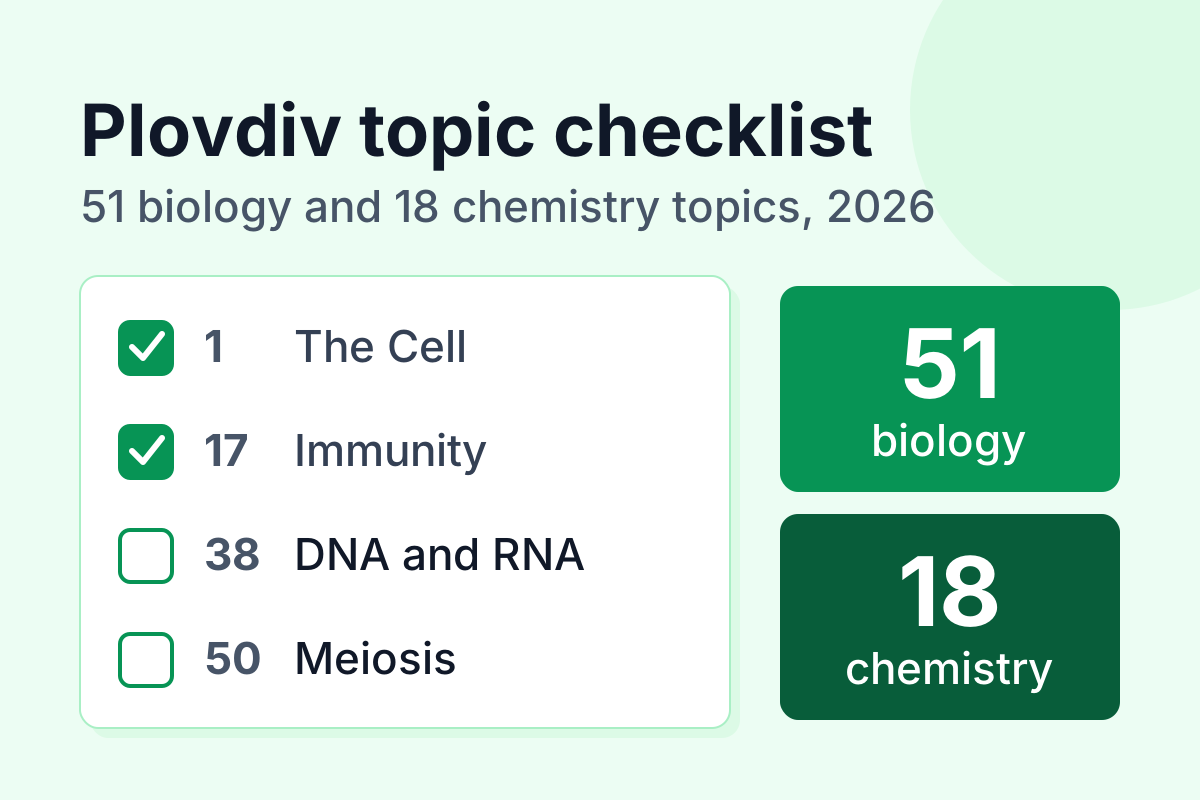
In short. Plovdiv's exam tests 51 biology topics and 18 chemistry topics. They are all below, in Plovdiv's own order, with its topic headings.
- Tick a box when you can explain that topic without notes. Or print this page.
- These are the 2026 lists. The 2027/28 lists are not published yet.
- The bracket on chemistry topic 11 is our summary of that topic's first line.
How to use this checklist
- Tick the boxes on your phone or computer. This browser remembers your ticks. Or print this page, or save it as a PDF from your browser.
- Start with the human body, topics 1 to 33. It is the biggest block.
- Learn one topic at a time from a school book.
- Tick the box only when you can explain the topic without notes.
- Then test yourself with Plovdiv's free past questions. Our past papers guide links to them.
Biology and chemistry each count three times in your score. So every topic here is worth your time.
Which book should you use?
Plovdiv's biology list names one book, in two parts:
- Biology and Health Education for 9th grade, part 1 and part 2
- by Vladimir Ovcharov and four co-authors
- a Bulgarian school book (ISBN 978-954-18-1360-7 and 978-954-18-1455-0)
The list names no English book. The chemistry list names no book at all.
So use a school biology book in English that covers the human body. Check its chapters against the topics below. Any topic your book skips needs a second source.
One free option in English: Anatomy and Physiology 2e, from OpenStax, free to read online. It may go deeper than you need. So use it for the body systems your school book skips.
Look for the body system each group of Plovdiv topics is about. Our matching:
| Plovdiv topics | Look for the chapters on |
|---|---|
| 1 to 4 | The cell, and tissues |
| 5 to 8 | The digestive system |
| 9 to 11 | The respiratory system |
| 12 and 13 | The urinary system |
| 14 to 18 | Blood, the heart, blood vessels, and the immune system |
| 19 to 21 | Bone, the skeleton, joints and muscles |
| 22 to 24 | The reproductive system, and development |
| 25 to 28 | The nervous system, including the autonomic nervous system |
| 29 and 30 | The endocrine system |
| 31 and 32 | The senses |
| 33 | The skin (the integumentary system) |
Biology topics 1 to 33: the human body
These 33 topics are two-thirds of the biology list. Most go one body system at a time.
| No. | Topic | Done |
|---|---|---|
| 1 | The Cell | |
| 2 | Tissues: Epithelial and Connective Tissue | |
| 3 | Tissues: Muscle and Nervous Tissue | |
| 4 | The Organism as a Unified Unit | |
| 5 | Digestive System: Nutrition | |
| 6 | Digestion: Digestion in the Oral Cavity | |
| 7 | Digestion in the Stomach and Intestines: Structure and Functions of the Intestines (Small and Large); Digestive Glands | |
| 8 | Hygiene and Health Knowledge of the Digestive System | |
| 9 | Respiratory System: Structure and Functions of Respiratory Organs | |
| 10 | Respiratory System: Breathing | |
| 11 | Hygiene and Health Knowledge of the Respiratory System | |
| 12 | Excretory System: Excretion | |
| 13 | Hygiene and Health Knowledge of the Excretory System | |
| 14 | Cardiovascular System: Heart and Blood Vessels | |
| 15 | Cardiovascular System: Blood | |
| 16 | Cardiovascular System: Heart Activity and Circulation | |
| 17 | Immunity | |
| 18 | Hygiene and Health Knowledge of the Cardiovascular System | |
| 19 | Musculoskeletal System: Structure of Bones and Joints; Skull | |
| 20 | Musculoskeletal System: Vertebral Column, Rib Cage, and Limbs | |
| 21 | Musculoskeletal System: Muscles | |
| 22 | Reproductive System: Male Reproductive System | |
| 23 | Reproductive System: Female Reproductive System | |
| 24 | Fertilization: Embryonic and Post-Embryonic Development | |
| 25 | Nervous System: Spinal Cord | |
| 26 | Nervous System: Brain | |
| 27 | Nervous System: Cerebrum | |
| 28 | Nervous System: Autonomic Nervous System | |
| 29 | Endocrine System: Pituitary, Pineal, Thyroid, and Parathyroid Glands | |
| 30 | Endocrine System: Pancreas, Adrenal Glands, and Gonads | |
| 31 | Sensory Systems: Visual Analyzer | |
| 32 | Other Sensory Systems: Auditory, Balance, Taste, and Olfactory Analyzers | |
| 33 | Skin: Structure and Functions; Thermoregulation |
Biology topics 34 to 51: cells and molecules
| No. | Topic | Done |
|---|---|---|
| 34 | Chemical Composition of the Cell | |
| 35 | Carbohydrates and Lipids | |
| 36 | Proteins | |
| 37 | Enzymes | |
| 38 | Nucleic Acids: DNA and RNA; Types of RNA | |
| 39 | Supramolecular Complexes: Viruses | |
| 40 | The Cell: Basic Unit of Living Matter | |
| 41 | Prokaryotic Cell | |
| 42 | Eukaryotic Cell | |
| 43 | Cell Membrane | |
| 44 | Non-Membranous and Single-Membraned Organelles | |
| 45 | Double-Membraned Organelles | |
| 46 | Cell Nucleus | |
| 47 | Genetic Processes: DNA Replication | |
| 48 | Realization of Genetic Information: Transcription and Translation | |
| 49 | Cell Division: Amitosis and Mitosis | |
| 50 | Meiosis | |
| 51 | Cell Cycle and Cellular Differentiation |
Words you may not know
These are our plain-English notes, not Plovdiv's words:
- Analyzer (topics 31 and 32): a sense organ with its nerves and its brain area. The eye is the visual analyzer.
- Hygiene and Health Knowledge (topics 8, 11, 13 and 18): how to keep that body system healthy.
- Supramolecular complexes (topic 39): very large groups of molecules. In this topic, that means viruses.
- Amitosis (topic 49): a simple, direct cell division, without the spindle you see in mitosis.
- Oxyacids (chemistry topic 9): acids that contain oxygen, such as sulfuric acid (H2SO4) and nitric acid (HNO3).
- Amphoteric (chemistry topic 10): able to react both as an acid and as a base. Aluminium hydroxide is one example.
- Hybridization (chemistry topic 11): how an atom's orbitals mix before it forms bonds. The carbon in methane is sp3.
Chemistry topics 1 to 7: general chemistry
| No. | Topic | Done |
|---|---|---|
| 1 | Atomic structure | |
| 2 | Chemical bonding | |
| 3 | Rate of chemical reactions | |
| 4 | Chemical equilibrium | |
| 5 | Solutions | |
| 6 | Electrolytes | |
| 7 | Oxidation-reduction reactions |
Chemistry topics 8 to 10: inorganic chemistry
| No. | Topic | Done |
|---|---|---|
| 8 | Properties of metals and nonmetals | |
| 9 | Chemical properties of basic and acid oxides, oxyacids and bases | |
| 10 | Amphoteric oxides and hydroxides |
Chemistry topics 11 to 18: organic chemistry
| No. | Topic | Done |
|---|---|---|
| 11 | Basic concepts (hybridization, bonds, isomerism, IUPAC naming) | |
| 12 | Hydrocarbons | |
| 13 | Alcohols and phenols | |
| 14 | Carbonyl compounds | |
| 15 | Carbohydrates | |
| 16 | Carboxylic acids | |
| 17 | Amines | |
| 18 | Amino acids |
Each chemistry topic has a few lines of detail in Plovdiv's programme. Read them before you tick a box. The bracket on topic 11 is our summary of its first line.
Where these lists come from
They come from Plovdiv's own 2026 programmes. Both are free PDFs in English:
- Biology programme 2026: the 51 topics and the rules for the six biology tasks
- Chemistry programme 2026: the 18 topics, each with a few lines of detail
The university can replace a file at any time. If a link stops working, start from Plovdiv's admission page.
What the exam looks like (2026 rules)
- Biology: 45 minutes, six kinds of task. Only task 1 is multiple choice.
- Chemistry: 30 multiple-choice questions in 45 minutes.
- No help: no calculator, no periodic table, no pen and paper.
- Lowest mark: you need at least 3.00 in each test, or you cannot be ranked.
Every date, fee and rule is in our free Plovdiv guide.
What our practice adds
Our practice follows this same list of topics. Every question comes with an explanation of the right answer and the wrong ones. It is multiple choice, so it does not simulate Plovdiv's written biology tasks. See the plans, and when practice access opens.
One email keeps the links in one place, this checklist among them. The guides are also free on this site.
Email me the free guidesTopic lists from the Medical University of Plovdiv's 2026 biology and chemistry programmes, read on 5 October 2026.
Free by email
Email me the free guides
Our 7 guides to Sofia and Plovdiv in one email, so you keep the links in one place.
- The printable Plovdiv topic checklist: every biology and chemistry topic, to tick off
- Plus 6 more guides: Sofia, Plovdiv, entry requirements, sample and past papers, and the score
Read next
All free guides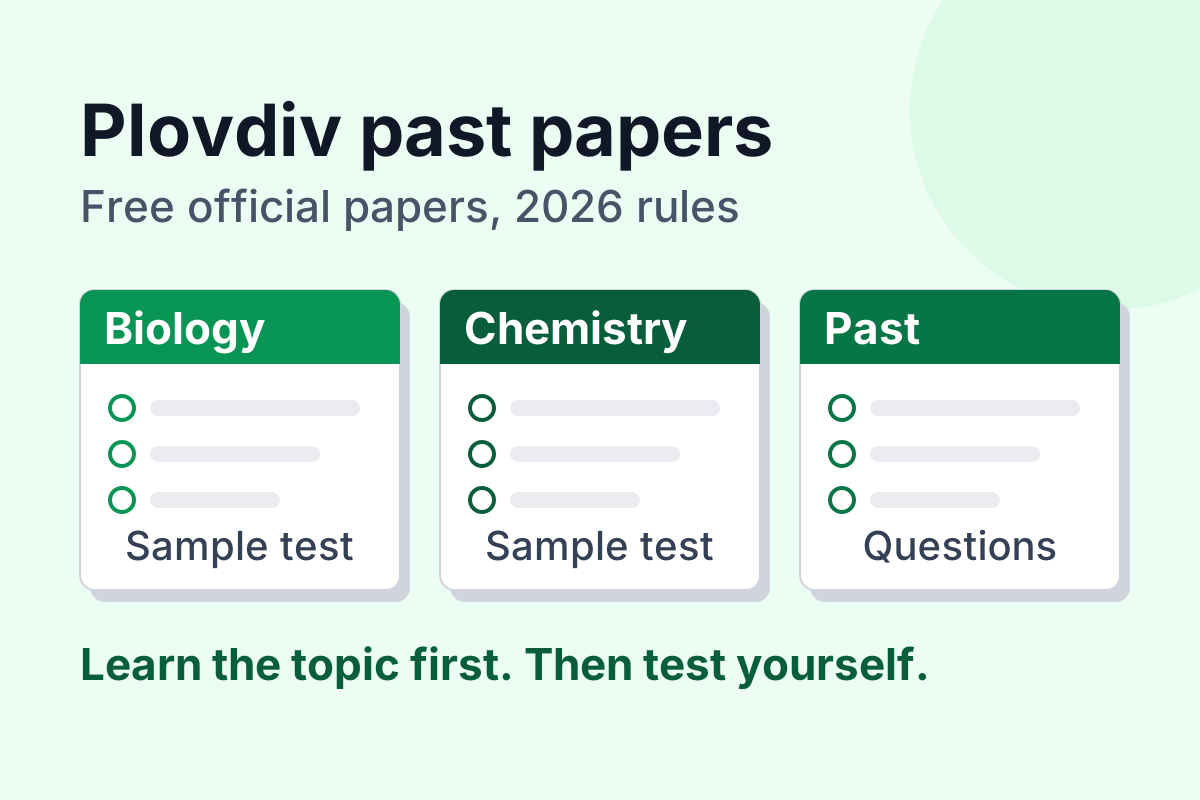
Plovdiv Past Papers and How to Use Them
Where to find Plovdiv's free sample tests and past questions, and how to use them without memorising answers. 2026 rules, for 2027/28 entry.
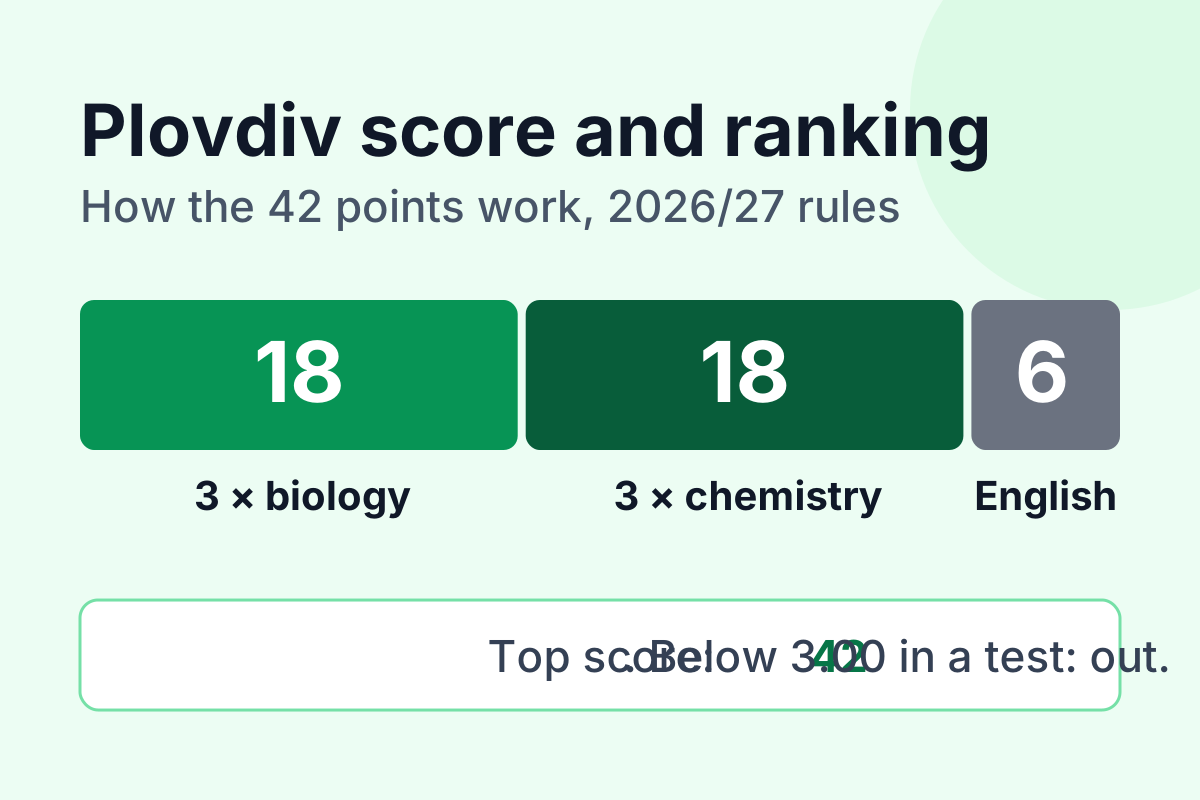
Plovdiv Exam: How the Score Works
How Plovdiv turns your biology, chemistry and English marks into a score out of 42, the 3.00 rule, how the 2026 rankings were scheduled, and what a re-sit costs.
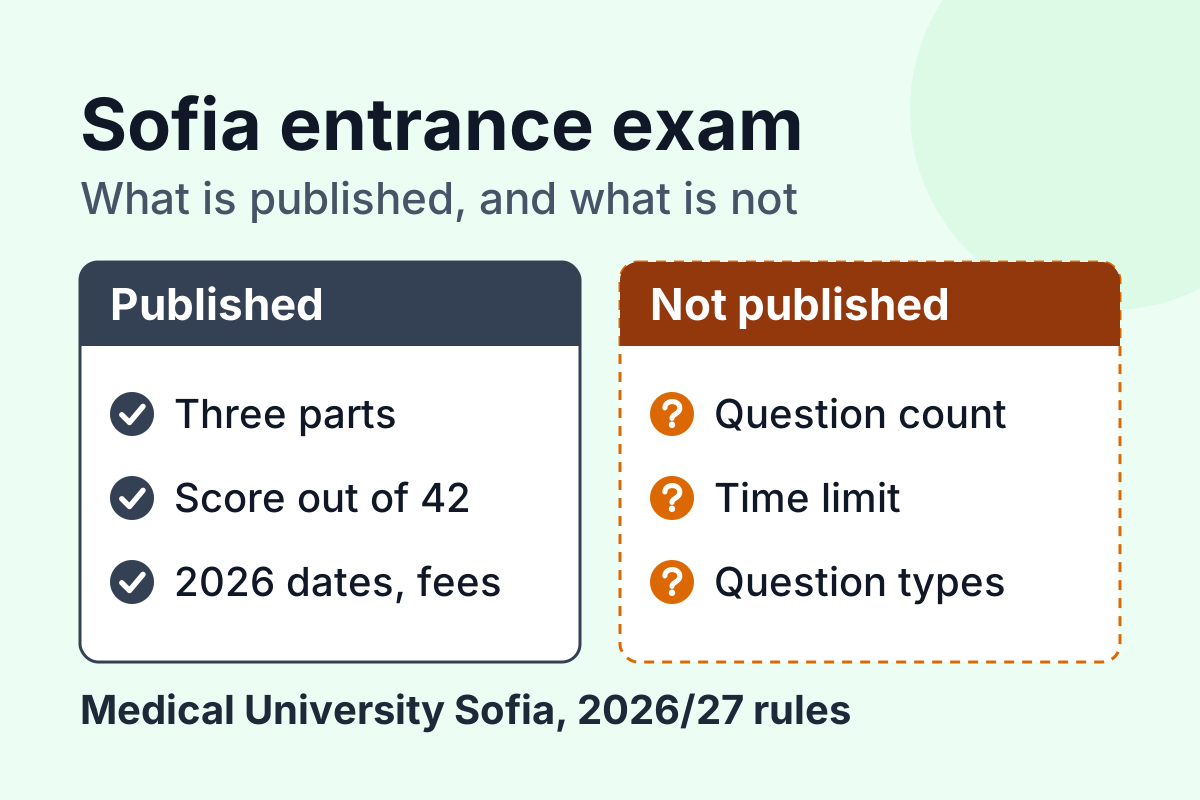
Sofia Entrance Exam: What Is Published
Is there a Medical University Sofia entrance exam sample PDF? Not on its admissions page. What Sofia publishes, what it does not, and how to prepare now. 2026/27 rules.